Cost of e-mail to the Reciever
We talk a lot about "work-load issues". Consider the impact of e-mail on the work load of teachers...principals...
--------------------------------------------
The cost of communication has never been lower, and as a result, lots of things get sent--e-mails, instant messages, text messages, you name it--that wouldn't be sent otherwise. An article in the New York Times discusses the frustration many professors feel when their students e-mail them about matters related only tangentially to class. One student at UC Davis, for example, asked a professor whether they should buy a binder or a subject notebook.
Students are aware that e-mail allows them to pester professors with requests that would not otherwise be worth making. The article quotes Cory Merrill, a student at Amherst, as saying "If the only way I could communicate with my professors was by going to their office or calling them, there would be some sort of ranking or prioritization taking place…Is this question worth going over to the office?"
The article says students are often unaware of the negative impact that trivial e-mails can have. Sending an e-mail imposes a cost on the receiver. We all know the cost of receiving spam. But even an e-mail from a friend, student, or professor places a demand on our time. An e-mail that requires a response or some kind of action imposes an even higher cost.
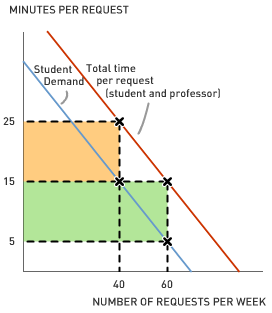 We can analyze the effect of easier communication, and the negative externalities that accompany it, using a simple demand model. Consider student demand for professor insights. The longer it takes to request something from a professor, the lower the student demand for insights. Time acts like a price in this model. We can plot student demand for a professor's time as a function of the amount of their own time it takes to place a request. For example, suppose getting an answer from a professor involves going to office hours, which takes 15 minutes of a student's time, but sending an e-mail only takes five minutes of a student's time. Then the ability to send e-mails effectively lowers the cost of getting a response from a professor from 15 minutes to 5 minutes. This increases the number of requests a professor gets--say, from 40 to 60 per week.
Now suppose that any student request, whether by e-mail or in person, takes up 10 minutes of a professor's time. The total cost per request is the amount of time it takes the student to make the request, plus 10 minutes of the professor's time. When students had to walk to a professor's office, only 40 requests per week were made--a total of 400 minutes (the area of the orange rectangle). With e-mail, requests are less expensive for students to initiate and the professor spends an additional 200 minutes per week responding to requests (the area of the green rectangle is 600 minutes). Making matters worse for professors, the new requests are those which weren't worth the students' time before, and are therefore lower-priority requests that often reflect the poor judgment or rudeness mentioned in the article.
1. The article mentions several things that professors were doing in the wake of the increased communication, from not answering e-mails to requiring students to reply to professors' e-mails. What market-based solutions to this problem might help reduce the number of requests professors get, and ensure that professors see and have the chance to respond to the most important requests?
2. Who owns the rights to professors' time--students, the professor, or the university? Is there any way to establish a market for professors' time? What if each student were given an allotment of professors' time at the beginning of the semester, and could sell their access rights to other students? Would such a system improve efficiency?
3. Can you think of another example in which something becoming cheaper led to undesirable results? (One that comes to my mind is a drop in gasoline prices leading to traffic congestion, but there are many others.) What solutions to that problem were proposed? Would a similar solution work in this case? Why or why not?
--------------------------------------------
I'm Imposing a Negative Externality on You Right Now.
OK, fess up. You've sent an e-mail you later came to regret. Maybe not much later. Maybe even a split second after you hit "send." And maybe to a professor or T.A.The cost of communication has never been lower, and as a result, lots of things get sent--e-mails, instant messages, text messages, you name it--that wouldn't be sent otherwise. An article in the New York Times discusses the frustration many professors feel when their students e-mail them about matters related only tangentially to class. One student at UC Davis, for example, asked a professor whether they should buy a binder or a subject notebook.
Students are aware that e-mail allows them to pester professors with requests that would not otherwise be worth making. The article quotes Cory Merrill, a student at Amherst, as saying "If the only way I could communicate with my professors was by going to their office or calling them, there would be some sort of ranking or prioritization taking place…Is this question worth going over to the office?"
The article says students are often unaware of the negative impact that trivial e-mails can have. Sending an e-mail imposes a cost on the receiver. We all know the cost of receiving spam. But even an e-mail from a friend, student, or professor places a demand on our time. An e-mail that requires a response or some kind of action imposes an even higher cost.
 We can analyze the effect of easier communication, and the negative externalities that accompany it, using a simple demand model. Consider student demand for professor insights. The longer it takes to request something from a professor, the lower the student demand for insights. Time acts like a price in this model. We can plot student demand for a professor's time as a function of the amount of their own time it takes to place a request. For example, suppose getting an answer from a professor involves going to office hours, which takes 15 minutes of a student's time, but sending an e-mail only takes five minutes of a student's time. Then the ability to send e-mails effectively lowers the cost of getting a response from a professor from 15 minutes to 5 minutes. This increases the number of requests a professor gets--say, from 40 to 60 per week.
Now suppose that any student request, whether by e-mail or in person, takes up 10 minutes of a professor's time. The total cost per request is the amount of time it takes the student to make the request, plus 10 minutes of the professor's time. When students had to walk to a professor's office, only 40 requests per week were made--a total of 400 minutes (the area of the orange rectangle). With e-mail, requests are less expensive for students to initiate and the professor spends an additional 200 minutes per week responding to requests (the area of the green rectangle is 600 minutes). Making matters worse for professors, the new requests are those which weren't worth the students' time before, and are therefore lower-priority requests that often reflect the poor judgment or rudeness mentioned in the article.
1. The article mentions several things that professors were doing in the wake of the increased communication, from not answering e-mails to requiring students to reply to professors' e-mails. What market-based solutions to this problem might help reduce the number of requests professors get, and ensure that professors see and have the chance to respond to the most important requests?
2. Who owns the rights to professors' time--students, the professor, or the university? Is there any way to establish a market for professors' time? What if each student were given an allotment of professors' time at the beginning of the semester, and could sell their access rights to other students? Would such a system improve efficiency?
3. Can you think of another example in which something becoming cheaper led to undesirable results? (One that comes to my mind is a drop in gasoline prices leading to traffic congestion, but there are many others.) What solutions to that problem were proposed? Would a similar solution work in this case? Why or why not?
posted by Mike at 5:40 AM


0 Comments:
Post a Comment
<< Home